The doors in the mind
Inspiration/Source: Book Giant Steps by Tony Robbins
3 minutes, 59.4 seconds!!!
A time that was said to be impossible for humans.
We're on May 6, 1954.
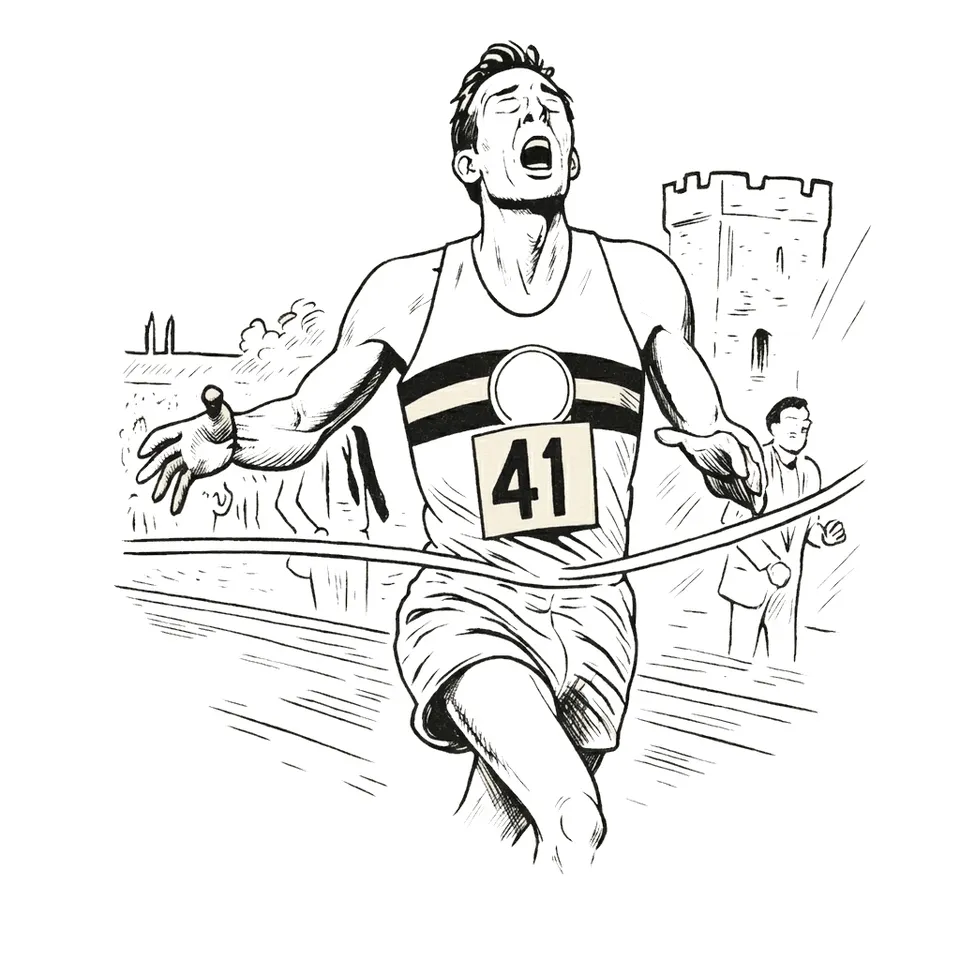
Roger Bannister just broke the mile record, finishing under the mythical four-minute threshold.
Initially, doctors had warned that the heart might give out, that the body would break.
Here's the funny part: within a year, dozens of other runners broke four minutes too.
The human body can't change that much in twelve months. So how did that happen? The beliefs changed.
The four-minute wall was never in the muscles. It was in the mind, and once one man walked through it, everyone could see the door.
Beliefs are what let us reach a goal, or stop us cold. If you don't think you can do it, you never will. As Tony Robbins says, your mind is incredibly powerful. So use it, train it. It's something you can work on. Your beliefs can become your brakes or your launching pad.
The crazy thing: beliefs don't even have to be yours. When people believe in you and treat you a certain way, they help you live up to it. Psychologists call it the Pygmalion Effect.
In 1968, two researchers, Rosenthal and Jacobson, ran an experiment in a California elementary school. They gave every kid an IQ test, then told the teachers a handful of students were "intellectual bloomers," kids about to take off academically.
It was a lie. The "bloomers" were picked at random. They were no different from anyone else.
A year later, those random kids had genuinely pulled ahead. Their IQ scores rose more than their classmates'.
Nothing about the children had changed, only what the teachers believed about them.
The teachers smiled a little more at the "bloomers." Gave them a beat longer to answer a hard question instead of moving on. Taught them more material, gave them warmer feedback, sat closer.
None of it was conscious.
They would have sworn they treated every kid the same. But their belief shaped a hundred tiny choices a day, and those choices shaped the kids.
What you believe about yourself, your kid, your teammate, your direct report doesn't stay politely in your head. It leaks. You feel it, and so do they. Over time, the belief becomes reality.
So if beliefs are this powerful, the real question is: can you choose yours on purpose?
You can! Robbins lays out a simple cycle.
First, name the limiting belief out loud. "I'm not a numbers person." "I'm bad at this."
Then challenge it. Ask yourself: is this true? Search for instances where this belief was proven wrong, in your own life or by others.
Then replace it with a better one, and rehearse it until it sticks. This is what Bannister did. He didn't just hope. For weeks before the race, he conditioned his brain to believe he could go below four minutes. He believed it before his body proved it.
Psychologists call this self-efficacy: your belief that you can actually pull off the thing in front of you. It tends to be self-fulfilling. People who believe they can try harder, last longer, and bounce back from stumbles, which makes them more likely to succeed.
So when you bump into walls, know that some of them are real but most of them are just beliefs someone handed you, a teacher, a coach, a mean comment you've carried for years and never thought to question.
Bannister found his door. You can find yours too.